Skip to content
Table of Contents
Fintech is growing again, but the rules of survival have changed. Global fintech investment rebounded to roughly 116 billion dollars across 4,719 deals, reversing three straight years of decline, even as deal volume slipped to its lowest level in nearly a decade, according to KPMG’s latest Pulse of Fintech. Capital is flowing to fewer companies, and investors now reward durable margins over growth at any cost. That single shift reshapes how a fintech startup should think about technology: every dollar of runway spent on infrastructure, security, and compliance has to earn its place.
At the same time, the regulatory and threat landscape has hardened. IBM’s most recent Cost of a Data Breach research puts financial services at the second highest breach cost of any industry, an average of 5.56 million dollars per incident, and the EU’s Digital Operational Resilience Act, known as DORA, is now firmly in force. For lean teams, the answer is rarely a larger headcount. It is a sharper operating model. This is where a managed IT partner, or an MSP for fintech startups, moves from a cost line to a strategic lever. Below are the six managed IT capabilities that separate fintech companies that scale cleanly from those that stall.
Quick answer
A fintech startup in 2026 needs six managed IT capabilities: cloud-native infrastructure management, advanced cybersecurity and threat detection, compliance and regulatory automation, scalable DevOps and CI/CD, real-time data analytics and monitoring, and end-to-end vendor management.
An MSP for fintech startups is a specialized managed service provider that runs these functions as a service, letting a lean team meet enterprise-grade security and compliance expectations without building a large in-house IT department.
Why Fintech Startups Need Managed IT in 2026
Fintech startups need managed IT because they must meet enterprise-grade security and compliance expectations with lean teams and limited runway. Three forces make that gap especially acute today, and each one widens the distance between fintech ambition and in-house capacity.
An Expanding Attack Surface
The attack surface keeps growing faster than teams can secure it. Akamai’s latest financial-services threat research found that 96 percent of organizations in the sector suffered at least one API security incident over the past year, the highest rate of any industry, alongside a 147 percent surge in advanced bot activity. For a fintech whose product is its APIs, you cannot shrink that surface. You can only instrument it.
A Talent Gap Lean Teams Cannot Close
The talent math does not work in-house. Recent workforce research counts roughly 3.5 million unfilled cybersecurity roles worldwide, with two in three organizations reporting real difficulty recruiting experienced security analysts. A seed-stage or Series A fintech competing with banks for the same scarce engineers will lose on price and lose on time.
Compliance as a Board-Level Mandate
Compliance is now a board-level obligation rather than a back-office task. These pressures help explain why the global managed services market, already worth around 330 billion dollars, is on track to approach 370 billion this year, according to Fortune Business Insights. Within that shift, managed services for fintech have become a strategic choice rather than a stopgap. The fintech IT requirements of today reward operators who buy proven capability and focus their own engineers on the product. Understanding the real fintech IT challenges below is the starting point for that decision.
The 6 Managed IT Capabilities Every Fintech Startup Needs
1. Cloud-Native Infrastructure Management
Modern fintech is born in the cloud, but cloud-native and cloud-managed are not the same thing. Reliable IT infrastructure for startups in this sector is less about picking a provider and more about disciplined management of multi-cloud and hybrid environments: cost governance, autoscaling, infrastructure as code, and resilience engineering that keeps services live during traffic spikes and regional failures. Resilience is not optional here. Akamai reports that nearly 80 percent of financial institutions have weathered a ransomware attack in the past two years, which makes recoverable, well-architected infrastructure a survival requirement rather than a nice-to-have. A managed partner brings reference architectures and 24/7 operations that a small team cannot staff alone, which is the essence of managed IT for startups. The business impact is direct: predictable cloud spend protects runway, and engineered resilience protects the customer relationships that funding now depends on.
2. Advanced Cybersecurity and Threat Detection
The economics of a breach favor speed over perfection. IBM’s research shows that breaches contained in under 200 days cost an average of 3.87 million dollars, while those that run longer cost 5.01 million, a penalty of more than a million dollars for slow detection. For fintech, where the average breach already sits at 5.56 million, the highest-leverage investment is not preventing every intrusion but compressing dwell time. A managed detection and response capability, backed by a 24/7 security operations center, is what converts that dwell-time math in your favor. The threat is also escalating in form: Akamai has tracked the median duration of network-layer DDoS attacks on financial services climbing more than sevenfold year over year, turning brief disruptions into sustained sieges. That is not a threat an on-call founder absorbs. It is one a managed SOC absorbs while the team sleeps.
3. Compliance and Regulatory Automation
DORA is the clearest example of why compliance can no longer be manual. Now firmly in force across roughly 22,000 EU financial entities, its reach extends to third-party ICT providers outside the EU that serve those entities. Many founders assume DORA is an EU bank problem. It is a supply-chain problem that can pull a non-EU fintech, and its vendors, into scope, with potential fines for critical ICT providers reaching 1 percent of average daily worldwide turnover. With regulators now shifting from transition into active enforcement, fintech compliance requirements now demand continuous control monitoring, evidence collection, and incident reporting workflows. Automating these through a managed it service partner turns audits from fire drills into routine exports, and turns compliance from a blocker into a sales asset for enterprise deals.
4. Scalable DevOps and CI/CD Optimization
Speed of shipping is a fintech’s competitive moat, but unmanaged pipelines quietly accumulate risk. The capability here is mature DevOps and DevSecOps: automated testing, secure build pipelines, secrets management, and progressive delivery that lets the team ship daily without shipping vulnerabilities. Security scanning embedded in the pipeline catches misconfigurations before they reach production, which matters when misconfigured endpoints remain a leading cause of financial-record exposure. The business impact is a faster, safer release cadence, with engineers spending their hours on product differentiation rather than on maintaining brittle deployment plumbing.
5. Data Analytics and Real-Time Monitoring
Fintech runs on data that is both the product and the risk. Real-time observability across infrastructure, applications, and transactions is what makes fraud detection, anomaly alerting, and capacity planning possible at scale. The same telemetry that flags a fraudulent transaction also flags the early signal of a breach or an outage, which is why monitoring and security are increasingly one discipline. A managed analytics and monitoring layer gives a small team enterprise-grade visibility, surfacing the operational and security insights that would otherwise require a dedicated data platform team. The impact is measured in faster incident response and in decisions made on evidence rather than instinct.
6. End-to-End Vendor and IT Ecosystem Management
A typical fintech stack stitches together a core ledger, payment rails, KYC and AML vendors, cloud services, and dozens of SaaS tools. Each integration is an attack vector and a compliance dependency, and third-party compromise is now one of the fastest-growing breach contributors. The capability that ties the other five together is governance of this ecosystem: vendor risk assessment, contract and SLA oversight, access management across tools, and a single accountable owner for the whole estate. DORA formalizes much of this through its third-party risk requirements. An MSP for fintech startups that owns vendor and ecosystem management removes the silent operational debt that accumulates when every integration is someone’s side responsibility and no one’s full-time job.

What Does a Fintech IT Architecture Look Like?
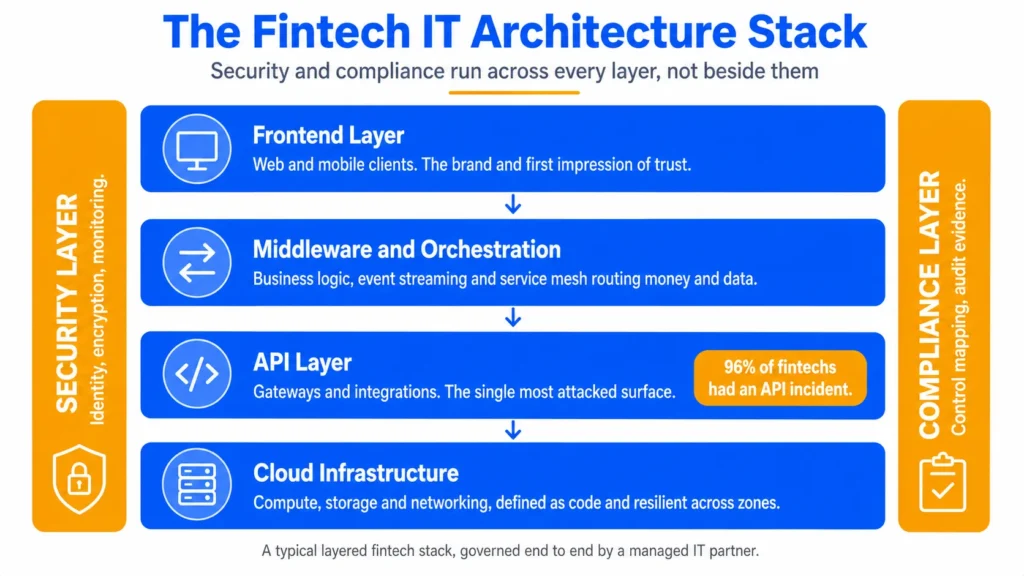
A modern fintech IT architecture is built in layers, from the user-facing frontend down to cloud infrastructure, with security and compliance running across every layer rather than sitting beside them. Understanding this fintech tech stack clarifies where managed support delivers the most value, and it makes the underlying fintech IT requirements concrete.
The Core Fintech Tech Stack
1. Frontend Layer
Web and mobile clients that demand performance and accessibility, since the interface is the brand and the first impression of trust.
2. Middleware and Orchestration
The business logic, event streaming, and service mesh that route money and data reliably between systems.
3. API Layer
The gateways and integrations that expose functionality, and the single most attacked part of the stack.
4. Cloud Infrastructure
Compute, storage, and networking, ideally defined as code and resilient across availability zones.
5. Security Layer
Identity, encryption, and monitoring woven through every layer rather than bolted on at the edge.
6. Compliance Layer
Control mapping, audit evidence, and reporting that spans the entire architecture end to end.
Where Outsourced IT Delivers the Most Value
This is where outsourced IT fintech models earn their keep. Few early-stage teams can staff specialists for all six layers, and integration between them, especially across third-party APIs and legacy core systems, is where most operational risk hides. A managed partner provides the cross-layer expertise that keeps the architecture coherent as the company scales, so the full fintech tech stack grows without quietly introducing a new point of failure when you add a payment rail or KYC vendor.
What Are Essential Fintech Security Best Practices?
Strong fintech security best practices are less about buying more tools and more about a coherent posture. Four practices carry the most weight for a scaling fintech, and each is an ongoing discipline rather than a one-time project.
Zero Trust Architecture
Never trust by default, verify every request, and assume the network is already hostile. With third-party compromise rising, identity becomes the real perimeter and continuous verification replaces the old idea of a trusted internal zone.
Endpoint Protection
Managed detection on every device and workload. Remote teams and contractor laptops are common entry points, so endpoint coverage cannot stop at the corporate office.
API Security
With API incidents now near-universal across financial services, rate limiting, schema validation, authentication hardening, and continuous API discovery are non-negotiable. You cannot protect endpoints you have not inventoried.
Encryption Standards
Strong encryption in transit and at rest, paired with disciplined key management, so that exposed data stays unreadable even when other controls fail.
Taken together, these fintech security best practices form a posture that a managed partner sustains continuously rather than a checklist completed once.
When Should a Fintech Startup Choose an MSP?
The decision is rarely whether to get help, but when. Managing IT for startups in a regulated sector raises the stakes, and a few clear signals indicate that an MSP for fintech startups has become the capital-efficient choice rather than a convenience.
Signs You Are Ready for a Managed Partner
- You are entering a regulated market or pursuing enterprise customers who require SOC 2, DORA alignment, or similar evidence before they sign.
- Your engineers spend meaningful time on infrastructure and security operations instead of product, the most expensive misallocation of scarce talent.
- You cannot recruit or retain dedicated security staff, an acute problem given 3.5 million unfilled roles globally.
- You need 24/7 coverage that a small team cannot physically provide without burning out.
Cost Versus In-House IT
When weighing an MSP for fintech startups, the honest comparison is not its fees versus zero. It is those fees versus the fully loaded cost of hiring, the opportunity cost of diverted engineers, and the tail risk of a multi-million-dollar breach or compliance failure.
Factor | Build In-House | Managed Partner |
Time to capability | Months to hire and ramp | Live in weeks |
Cost structure | High fixed salaries and tooling | Predictable operating expense |
24/7 coverage | Hard to staff, burnout risk | Built in |
Specialist expertise | Scarce and expensive to retain | Shared across clients |
Compliance depth | Learned on the job | Pre-existing frameworks |
Scalability | Re-hire to grow | Scales with the contract |
Mapping Support to Your Growth Stage
Most fintechs start with a managed partner for security and compliance, the two areas where mistakes are existential, then expand the engagement as the architecture grows. The model scales with the company rather than forcing a premature build-out of IT for startups that the balance sheet cannot yet justify. Early stage favors outsourced security and compliance; growth stage adds managed cloud and DevOps; scale stage shifts toward a hybrid model where an internal team owns strategy and the partner runs operations. A capable MSP for fintech startups can flex across all three stages.
Key Takeaways
- Fintech funding now rewards lean, capital-efficient operators, so every IT dollar has to earn its place.
- Six capabilities define a resilient fintech: cloud infrastructure, cybersecurity, compliance automation, DevOps, real-time monitoring, and vendor management.
- Breach economics favor speed over perfection, so a 24/7 managed SOC that compresses detection time pays for itself.
- DORA extends compliance obligations to fintechs and their vendors, even those based outside the EU.
- An MSP for fintech startups is usually the capital-efficient choice for security and compliance first, then expands as the company scales.
Conclusion
The fintech companies that win in 2026 will not be the ones with the largest IT departments. They will be the ones that run lean and resilient, directing scarce capital and talent at their product while an MSP for fintech startups carries the infrastructure, security, compliance, DevOps, monitoring, and vendor governance that the modern threat and regulatory landscape demands. With breach costs near record highs, DORA entering enforcement, and investors rewarding durable operators, managed IT has shifted from an optional efficiency to a core part of how a serious fintech is built. The question is no longer whether to adopt these six capabilities, but how quickly you can put them in place before they become table stakes.
Ready to see how Zazz can transform your IT operations? Schedule a consultation with our enterprise IT specialists today.